
In the previous posts in this series we have been looking at problems with the traditional project methodology (Waterfall), looked at how to organize your company for best results in digital projects and given tools to in practice work agile. What we have not discussed, is the role leads have in Agile organizations, and how important a good feedback structure and a feedback culture is for Agile to function well.
In my opinion the Feedback Culture and how it is implemented is a crucial factor, and now it is time to have a closer look at this aspect.
Building a Feedback Culture
Feedback culture is, of course, a mindset within the company. However, it also needs rules, structure and rituals to fully function. Not only this, but the feedback culture should also be intrinsically connected to performance reviews.
To set some ground rules, a strong Feedback Culture can only exist if…
- People feel safe to give feedback
- Feedback is welcomed as an opportunity to grow
- Feedback is given and accepted top-down, bottom-up and horizontally
- Leads who punish people that give constructive feedback are duly handled by the HR/People’s organization
- Severe problems with leads and/or other upper management behaviour can be addressed in an anonymous way through a safe channel
- Feedback is used by leads and employees to create valid and meaningful development plans for the individuals
- Feedback is given in a structured way: Situation – Behavior – Impact – Next Steps (SBI-N Model). With this structure the feedback does not become an opinion, but anchored in reality
- Important to remember is that Next Steps is something that can come some time after the feedback has been given (or not at all).
- There are established rituals for reflection, improvement and feedback
- Feedback and development is part of the 1-on-1:s the lead has with her employees
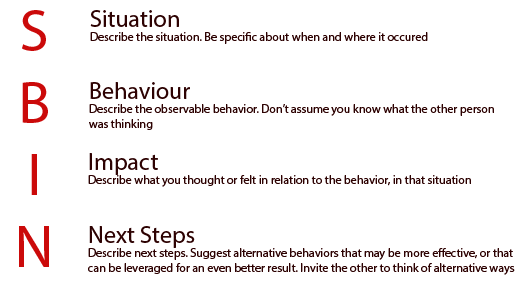
The “N” in the SBI-N model is very important. A lot of people expect a receiver of feedback to automatically accept the feedback and mend his/her ways. This is a wrong assumption.
Someone who receives feedback may find it totally unjustified and it is the receiver’s right to handle the feedback as he or she sees fit.
| Remember #1: Feedback is a gift. The gift should be handled like a raw egg; You hand it over with care and the receiver can decide what to do with it. No one is obliged to act on the feedback given. Remember #2: Be specific. A feedback giver that tells the receiver: “you need to be more spontaneous”, or “you need to communicate better”, is not doing anyone any favors. Follow the ISB-N model and you will be fine in most cases. |
The Lead’s role for an open Feedback Culture
Some time ago, when I took over three existing teams with poor team spirit, low satisfaction and a built-in distrust of leads and colleagues in other teams, I realized that it was only with honest feedback from the teams and their members that I could work to improve the situation.
It proved almost impossible to get anyone to speak up about their concerns and the reasons for the bad situation, so I introduced a few techniques to break the vicious circle:
- The teams were encouraged to book a meeting without my knowledge of where and when, where they could discuss me, my superiors, their discomfort, their worries, their pain points etc, in a safe environment. I also asked them to select one or more spokespersons from the team that would deliver the information to me.
- I introduced feedback lunches. Every second week I had a blocker where any team member could book me for a lunch that I paid for, and where they could discuss anything they wanted, without anyone else knowing that the lunch would take place.
- I actively asked for feedback myself, both in specific situations and in general
- I openly presented the results of the quarterly employee survey and highlighted bad and good things. Special focus was given to the perceptions of me and the other leads in the “tribe”, to show that transparency is key for improvements
- I encouraged the team leads to also become more transparent, actively ask for feedback, and drill deep in satisfaction issues
Some time later, this approach was picked up by the department where I worked, and the People’s department actively promoted these approaches. This meant, among other things, that Lead Feedback Sessions were introduced. Here the entire teams gathered together with a Business Partner from the People’s Organization to give feedback according to the agile principles of “What to Continue to do”, “What to Stop doing”, “What to Start doing”
Another important aspect of this are the 1-on-1:s that all leads should have at least every second week with every employee. I used the structure, that for employees who wished weekly 1-on-1:s we put aside 30 minutes/week. For the ones that wanted them every second week, I put aside 60 minutes.
| Worth noticing: A lot of traditional companies use the 1-on-1:s mainly to discuss the week’s tasks and hence as a kind of planning meeting. In an Agile environment this may still be needed, but much less so, since the teams and individuals are more autonomous and take greater individual responsibility. They are well aware of what needs to be done, what the priorities are and can thereby be trusted to carry out the tasks without micromanagement from the lead. However… Also in an Agile environment there may be individuals who are not performing, do not take responsibility or need more hands on guidance. Therefore the lead needs to adjust her behavior accordingly, and thereby have a focus on the employee’s needs and adapt the structure of the 1-om-1:s. My rule of thumb is: See the person and set the individual in the center of the discussions. |
Tools for Feedback Culture and Personal and Professional Growth
A good feedback culture has institutionalized tools and frameworks as well as a plan for how to use the feedback for personal and professional growth.
- 360-degree feedback for professional and personal development as well as a for promotions or improvement cases
- It is recommended that a tool for feedback rounds is put in place. It should reflect company values as well as aspects of the individual’s job family and role
- A clear classification of job families and roles with expectations should be available for all employees
- Leads are responsible for writing a summary of the feedback given, The employee will never see the individual contributors comments or rating. The employee will see the summary and a spider chart which reflects how well the employee lives values and preforms his/her work
- To ensure objectiveness a Review Committee is responsible for taking the final decision about Improvement Needed or Promotions. Not the lead.
- Quarterly pulse and health checks for continuous improvement and detection of troubled teams
- The pulse check should reflect core values of the company. Such as: “I see that all people are treated equally”, “I would recommend my lead to other employees”, “We collaborate in a good way between teams”, “I am fairly rewarded for my work”, etc.
- The statements are then clustered in a number of KPIs such as “Engagement”, “Impact”, Recognition”, etc.
Team and cross team feedback
Not only individuals need structured Feedback. Also teams need this.
In a company that adapts to Agile Methodologies, we constantly reevaluate how we work and how we collaborate. It is not unusual with friction between teams due to varying priorities, bad communication or lack of insights. Therefore we have tools to mitigate this.
Retros
Retros are one of the main pillars of Agility and is a forum for a team (and in some cases for more teams) to look back at a specific project or time period. They can be led by a facilitator (producer, agile coach) who ensures that tone of voice is ok and that feedback is given in a correct way. Outcome form the sessions are normally “What went well (what to continue)”, “What can be improved”, “What should we stop doing” and “What should we start doing”.
Feedback Sessions
There are three kinds of feedback sessions (apart from the spontaneous feedback and the 1-on-1:s that a lead should regularly have with each employee);
- Feedback for Leads
A forum for a full team to give feedback to the lead in a safe space with a facilitator. - Team Feedback Sessions
These sessions are always held by a seasoned facilitator. These sessions are used when there is friction within a team, a team member does not function etc. - Postmortems
These are held after the completion of an initiative/project and are longer sessions than Retros. These should be held by a seasoned facilitator, since there is a risk that they turn into Blame & Shame Events. Especially if there have been troubles and several teams were involved.
How do we maintain a good Feedback Culture?
Most people think that the management set the culture for the company, and this may be true when we want to change our current culture or when we are starting a new company. In other situations, such as the running of the day-to-day business, the management should no longer form the culture, but the culture should be forming the management. I know this may sound strange, but the reason for my strong opinion in this matter is that power corrupts, and I have seen enough leads not living the culture they impose on others to have formed another model, where the culture is the foundation for everything else.

- With the correct mindset, follow-ups, framework, tools and open feedback culture, we build the company through its culture, values and objective employee evaluation.
- Leads need to be reminded that the team does not work for the lead. Instead, the lead works for the team and its members.
- The lead’s main responsibility (apart from professional/personal development) is to be a catalyst, facilitator, setting the general direction and solve conflicts.
- The teams should be self organizing to the biggest degree, so that we thereby leverage the experts and make people grow.
- A lead should not be the expert of the tasks to perform in the team. The lead should be an expert in leading and coaching.
| Remember: The team does not work for the lead. The Lead works for the team! |
The feedback ecosystem
As described in this article, a strong Feedback Culture needs tools, structure and rituals to fully function.
To help you understand how this all fits together I have created the below map:

The PKR-box in the upper center, stands for Personal OKR:s. These ones are very good to use for specific tasks or objectives the employee has. Especially if we have a situation where improvement in performance is needed. You can read about OKR:s in this article.
I hope this topic has given you some insights, and although there is a lot of information to digest, there is still more to add around this topic. If you want help to deep dive into how to build a good culture and good leadership standards, do not hesitate to reach out.
In the next part of this Crash Course in Agile for Traditional Companies, we will look at alignment and autonomy between Agile teams.
 Claes' Business Insights
3 thoughts on “Part 7: Leadership and Feedback Culture”